tirsdag den 28. januar 2014

Sue Randolph

Kirstine, Nanna, Andrea og Natascha


"Sue Randolph, 39, grew up in Saudi Arabia and earned her master's degree in Arabic at the university of Michigan." p.25, l. 13-14.

"I joined the Army because I had $65.000 in student loans." p. 25. l. 20


"Iraq looks like it's straight out of the Bible."


Brian, Sasja og Josefine - Sue Randolph


Picture 1.
"Since i had a master's in political science - Middle East studies and Arabic..."
Picture 2.
"..I felt like I was part of a big machine that was going to help them have a better life."
Picture 3.
"We have no comprehension of the psychological of this war."

fredag den 10. januar 2014

Kurt Vonnegut Jr.

Kurt Vonnegut Jr. Was an American author. He was born at November 11th 1922 and he died at April 11th 2007. His father (Kurt Vonnegut) and his grandfather (Bernard Vonnegut) were architects in the Indianapolis firm Vonnegut & Bohn.
Vonnegut’s most famous works are “Cats Cradle” (1963), “Slaughterhouse-Five” (1969) and “Breakfast of Champions” (1973). He wrote in the genres satire, gallows humor and science fiction.
Kurt Vonnegut Jr. had an older brother (Bernard Vonnegut) and a sister (Alice Vonnegut). His mother committed suicide with sleeping pills when Vonnegut was 22 years old. Kurt Vonnegut was also an artist. In May 1940 he graduated from Shortridge High School and went to Cornell University to study chemistry. While he was at Cornell University he enlisted at United States Army. After that he went to the Carnegie Institute of Technology and the University of Tennessee to study mechanical engineering.

When Vonnegut went home after the Second World War he got married with Jane Marie Cox and they had three kids. They got divorced in 1979 and Vonnegut married another woman called Jill Krementz. With her he adopted a little girl. Vonnegut also adopted his sister’s three kids when Alice Vonnegut died of cancer in 1958. Alice’s husband died in an accident two days before Alice died.

onsdag den 4. december 2013

The use of high-angle, low-angle and eye-level in film


Matrix groups about cinematic technique

Round 1: Researching terms

  • All groups are responsible for one of the terms on the film analysis sheet.
  • You must be able to explain what the terms mean.
  • You must find examples of each of the terms
    • Either make them yourselves (drawing for instance)
    • Or find pictures / clips online (search on terms on youtube for instance)

Remember that this is matrix groups so all of you must be able to explain it on your own and have the examples ready to show the others.

Group 1: Framing
Group 2: Angles
Group 3: Lines
Group 4: Composition
Group 5: Sound
Group 6: Lighting and colour


Time frame: 15 minutes


Round 2: Presenting terms

In the new groups you must now present your findings to the people who worked with something else.

Remember to have your examples ready so it can run smoothly :)

tirsdag den 3. december 2013

Coward: Characterising through cinematic technique 2

Watch the following two scenes one at a time and characterise Andrew and/or James based on them.
Discuss what cinematic techniques are used to characterise them. You can find the film here.

Comment on the use of framing, angles, lines, composition, sound and lighting when relevant.

Clip 1

5:21 - 6:51


Clip 2

15:58 - 17:10

Coward: Characterising through cinematic technique 1

Task

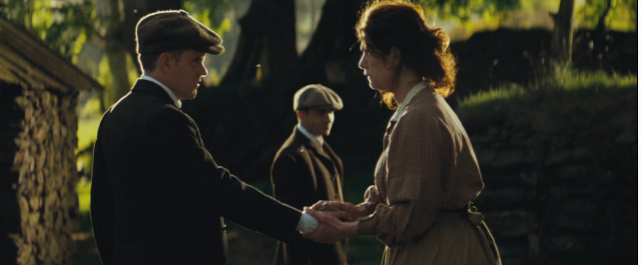
Characterise Andrew and James and their relationship to others and the war based on these four freeze-frames from the short film.

When you analyse the pictures you must use relevant vocabulary to describe what you see and the effect it has. Comment on framing, angles, lines, composition and lighting when it is relevant.


Freeze-frame 1 (1:23)


Freeze-frame 2 (2:42)

Freeze-frame 3 (3:19)

 
Freeze-frame 4 (20:11)

onsdag den 27. november 2013

Wilfred Owen

Wilfred Owen was born on 18th march 1893 and died 4th November 1918. He was a British poet, and was in the British army as well. In the summer of 1917, Wilfred went to a hospital in Edinburg for treatment for a shell shock, where he met Siegfried Sassoon, who also was a poet and an officer. This meeting with Siegfried changed Wilfred’s poesy to realism about the war. 
Wilfred Owen was born in Weston Lane in Shropshire. He is half English and half welsh. He was the eldest of 4 children. 
In 1898, Wilfred’s father, Thomas, got a job as stationmaster in Birkenhead at Woodside station, where they had no less than three homes. Wilfred was educated from Birkenhead Institute and later Shrewsbury Technical School. Wilfred was raised as an Anglican, and was in his youth a very strong believer. He had throughout his whole life, a strong relationship to his mother. 
In 1911 he passed his exam at the University of London, but not with the first-class honours, which was needed to get a scholarship, which was the only way his family could afford him to study there. 
In 1913, Wilfred went to Bordeaux, France to teach in English and French.
Wilfred was killed at the age of only 25, in the first world war, in the Sambre-Oise Canal in France, only one week before the end of the war. 


Mette Haarup

tirsdag den 26. november 2013

Siegfried Sassoon

Siegfried Loraine Sassoon

Siegfried Sassoon by George Charles Beresford (1915).jpg
Siegfried Sassoon is born 8 September 1886 and died the 1 September 1967 in a ages of 80 by stomach cancer. Siegfried Sassoon was an English poet, novelist, biographer and soldier. Decorated for bravery on the Western Front. He became one of the leading poets of the First World War.
He was born and raised in Matfield in England. His father Alfred Ezra Sassoon was Jewish and his mother Theresa Sassoon was an Anglo-Catholic. Sassoon was the second son of three sons, the others was called Michael and Hamo.
During Sassoons youth his biggest interest was fox-hunting, because he did not finish his studies and in this period he wrote some poetry, but did not get much intention. In 1914 he got into the army after the outbreak to World War 1. But a broken arm prevented him to get in battle. He came first in active battle in 1915. 1 November same year his younger brother Hamo was killed.

Sassoon was homosexual but got married to Hester Gatty and got his only son George. The marriage ended after the Word War 2.
And apparently he got a “relationship to the author and soldier Wilfred Owen, that we had read the famous poem “Dulce et Decorum Est”. Siegfried Sassoon met Wilfred Owen at the military school, and in 1917 they were both in a hospital in Edinburgh for shell chock.


The genre he wrote was Poetry, Fiction, Biography. 

Written by Nanna Gjesing

Siegfried Sassoon, "Base Details"

Consider the fact that the title of this poem might have a double meaning! What could it be?

Listen to the poem here.